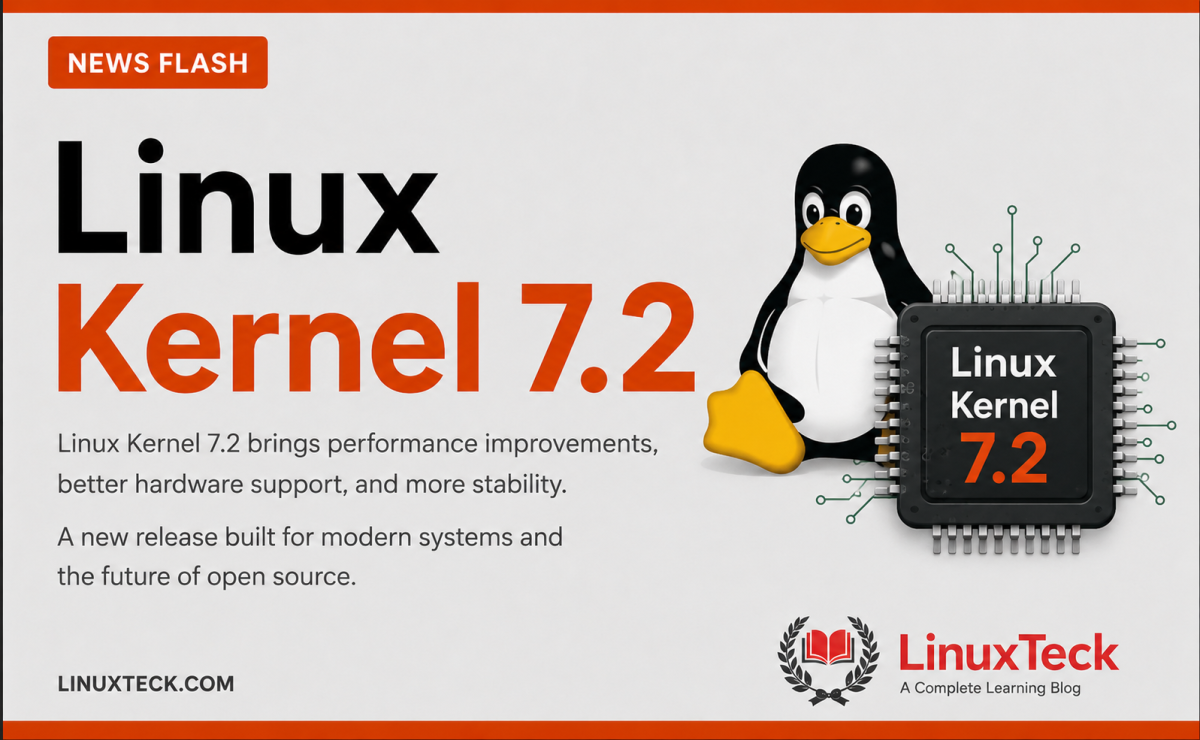
Linux Kernel 7.2 RC1 dropped on June 28, 2026, and the source tree has officially blown past 43 million lines of code. Linus Torvalds closed the merge window with updates from over 200 subsystem maintainers, a PCIe fix that has been causing headaches since 2023, and the removal of drivers for hardware that almost certainly nobody uses anymore.
Highlights
| 1 | The Linux kernel source tree now totals 43,898,743 lines across 108,158 tracked files, with 33.6 million being actual code and the rest being comments and blank lines. |
| 2 | The AMDGPU and AMDKFD graphics driver remains the largest single subsystem in the kernel at 6,356,056 lines, up from 6.1 million in Linux 7.1. |
| 3 | A PCIe fix resolves a 2023 regression where hot-plugged devices could get permanently stuck at 2.5 GT/s link speeds instead of negotiating faster connections. |
| 4 | Legacy drivers removed include the driver for the 35-year-old DoubleTalk PC ISA speech synthesizer card and the PROFIBUS driver ported from SCO Unix in 1998. |
| 5 | The strncpy API has been fully eliminated from the kernel after six years of cleanup work spanning over 360 patches across multiple release cycles. |
| 6 | Rust language integration received further updates, with ongoing work to bring memory-safe code into more kernel subsystems beyond the initial driver modules. |
This release cycle tells a familiar story for the Linux kernel. It keeps growing, but not recklessly. New hardware support goes in while dead weight gets cut. The numbers are big but they make sense when you consider the kernel has to run on everything from Raspberry Pis to enterprise server racks. What stands out this time is how many long-standing issues finally got resolved.
| Total Lines | 43,898,743 |
| Actual Code | 33,653,681 lines |
| Source Files | 108,158 files |
| RC1 Release Date | June 28, 2026 |
What Changed During the Merge Window
The two-week merge window closed with Torvalds noting that things looked "reasonably normal" for this release cycle. Over half the patch volume came from driver updates, which is typical. A big chunk of that was AMD GPU register definitions, something that happens regularly as AMD expands its open-source graphics support. Strip that out and the rest is a normal spread of architecture updates, tooling fixes, documentation, and core kernel changes.
Subsystem maintainers submitted pull requests covering just about every corner of the kernel. Filesystem work touched Btrfs, EXT4, XFS, and F2FS. Networking got both core and driver-level improvements. Memory management saw refinements targeting better performance on high-load systems. The Rust integration work continued expanding with updates and fixes from Miguel Ojeda's team. The sched_ext code got restructured after complaints about code quality, which is worth watching if you follow scheduler development.
43 Million Lines and Still Growing
Linux 7.1 sat at roughly 42.9 million lines. Version 7.2 jumped to nearly 43.9 million, adding close to a million lines in a single release cycle. That sounds like a lot until you look at where the growth actually happens. The AMDGPU driver alone accounts for 6.3 million lines and grew by about 189,000 lines from 7.1 to 7.2. Modern GPU drivers are complex beasts and AMD's commitment to open-source kernel graphics support means the code keeps expanding.
Even with active removal of obsolete drivers, i486 support getting dropped recently, and ongoing cleanup of dead code paths, the kernel tree continues growing. That growth is driven by real hardware support needs, not carelessness. New SoC platforms, accelerator devices, and storage controllers all need driver code, and the kernel is where it goes.
The PCIe Speed Fix That Matters
One of the more practical fixes in 7.2 addresses a PCIe regression from 2023. The kernel had a workaround for link training failures that applied a 2.5 GT/s speed clamp. Problem was, in hot-plug scenarios, that clamp could stick around even after the device causing the issue was removed. So you would plug in a new PCIe device and it would be stuck running at the slowest possible speed for no good reason.
The fix discards the vendor and device ID matching in the failed link retraining quirk and properly reverts to the original target link speed when retraining succeeds. If you run servers with hot-swappable PCIe hardware or use external drives via Thunderbolt, this is the kind of fix that matters in production. The patch is also getting backported to stable kernel versions, which is good news for anyone not tracking mainline releases closely.
Separately, Intel QAT, DSA, and IAA accelerator devices got added to the peer-to-peer DMA whitelist, and a new PCI driver for the UltraRISC DP1000 PCIe controller was merged.
Legacy Drivers Get the Axe
Linux 7.2 removes two drivers that have been collecting dust for years. The first is the RC Systems DoubleTalk PC ISA speech synthesizer driver. This card came out in 1991 and the dedicated driver has only received minor cleanup patches since the Linux 2.6 days. The hardware itself still works through the Speakup accessibility driver, so nobody loses functionality here. The maintainers simply removed redundant code that nobody was actively using.
The second removal is the PROFIBUS driver, originally ported from SCO Unix back in 1998. Both removals follow the same logic: if nobody is using the code and somebody still has to maintain it, the math does not work out. Removing these reduces the testing surface and frees up maintainer bandwidth for things that actually need attention. Users who still need this hardware can continue using long-term support kernel branches where these drivers remain available.
Things look reasonably normal for this release, knock wood. I hope it's going to be a fairly calm week.
Linus Torvalds, Linux 7.2-rc1 Announcement, June 2026
Hardening and Security Updates
Security-focused changes in 7.2 include the complete removal of the strncpy API. This has been a multi-year effort spanning over 360 patches to eliminate a function known for buffer overflow risks. Kees Cook's hardening updates continue making the kernel more resistant to common exploit patterns, and the security hardening work in the kernel keeps building on previous cycles.
SELinux, AppArmor, and Landlock all received updates this cycle. The IMA and EVM subsystems gained post-quantum ML-DSA signature support, which is forward-looking but increasingly relevant as quantum computing timelines get more concrete. TPM module handling also saw improvements. For Secure Boot users on Linux, these kernel-level security updates are worth tracking even if they do not require immediate action.
What Distros Should Expect
The 7.2 kernel will follow the standard rc cycle through July, with weekly release candidates leading to a stable release probably around mid-to-late August 2026. Rolling release distributions will pick it up quickly. Fixed release distros like Fedora 44 and Ubuntu 26.04 LTS may include it in upcoming point releases or ship it in their next major version depending on timing.
If you are running 7.1 or an LTS kernel in production, there is no urgent reason to jump to 7.2 right now. The PCIe fix is getting backported anyway. But if you want the latest driver support, the expanded Rust integration, and the security improvements, testing 7.2 in a staging environment once it stabilizes is a reasonable next step.
What to Watch For Next
The stabilization phase is where regressions surface. Torvalds mentioned he would be taking the first week mostly off while still monitoring email, so expect a quieter start to the rc cycle. Key areas to watch include the sched_ext restructuring that happened after code quality complaints, the memory management improvements that showed promising benchmark results during development, and whether any PCIe regressions pop up from the hot-plug fix.
The kernel development process remains remarkably consistent even as the project scales. Hundreds of maintainers coordinate across time zones, patches get reviewed and merged on a predictable schedule, and the rc cycle gives everyone time to test before the stable tag goes on. That is how you manage 43 million lines of code without things falling apart.
Sources & References
LinuxTeck - A Complete Learning Blog
Tech News Stay updated with the latest Linux and open-source news, covering new releases, distro updates, security patches, and enterprise developments, delivered in plain language for sysadmins and developers.