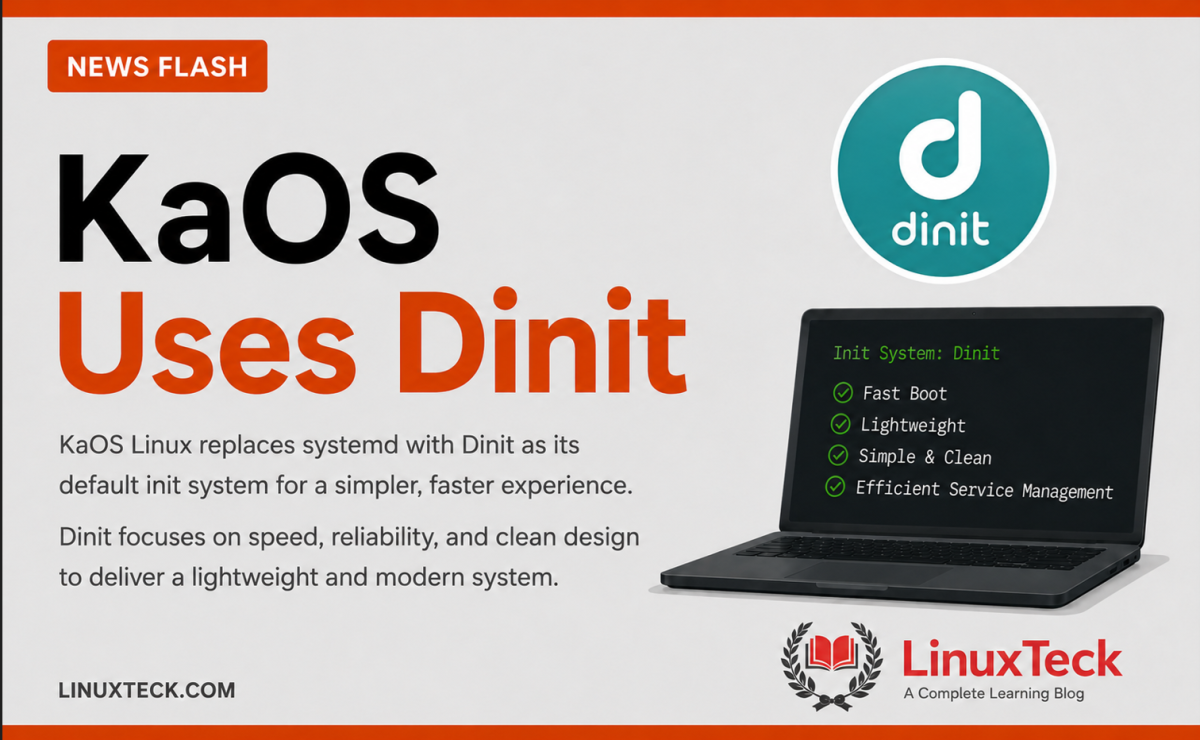
KaOS Linux has shipped its first stable ISO fully powered by Dinit, marking the completion of a three-year engineering effort to move beyond systemd while keeping the distro sane and usable. The KaOS Dinit 2026.06 release, arriving June 23, 2026, closes the transition that began as a response to upstream systemd changes that left the team in a bind: systemd 254 dropped support for split /usr setups, later versions killed AUFS compatibility, and KDE Plasma's growing systemd dependency made things worse. KDE Plasma and KWin have been replaced by Niri and Noctalia as the default graphical shells, but the system remains fully focused on KDE and Qt applications rather than GTK software.
Highlights
| 1 | KaOS Dinit 2026.06 arrived June 23, 2026 as the first stable ISO built entirely on Dinit after nearly three years of engineering effort and testing cycles. |
| 2 | Dinit, Turnstile, and seatd work together as modular replacements for the broad scope of systemd's init, session, and seat management functions. |
| 3 | KDE Plasma and KWin are replaced by Niri and Noctalia as the default desktop shells in the stable release. The system remains Qt and KDE-application focused (Elisa, Falkon, Octopi, KDE suite) rather than GTK-based. |
| 4 | A clean installation via the new Dinit ISO is the recommended deployment method. While traditional non-Dinit repositories remain available, the Dinit architecture represents a significant system-level change better suited to fresh setups rather than live in-place upgrades. |
| 5 | The distro remains partially systemd-dependent: udev, tmpfiles, and elogind stay in place for hardware detection and polkit privilege escalation to work properly. |
| 6 | Limine replaces GRUB as the default bootloader, and greetd with tuigreet replaces SDDM display manager for better alignment with the new Wayland-based session stack. |
The stable release finalizes KaOS's move to Niri and Noctalia as default desktop shells while keeping Dinit as the core init system. This dual shift has been in development for years: moving init away from systemd required rearchitecting session management and seat handling, and reimagining the desktop meant finding Qt-native alternatives that could work without systemd's session infrastructure. KDE Plasma and KWin no longer ship by default, but KDE and Qt applications form the foundation of the user experience. The distro stays laser-focused on one toolkit and one init philosophy rather than supporting multiple approaches.
| Release Date | June 23, 2026 (Stable) |
| Init System | Dinit 022 (with Turnstile, seatd) |
| Desktop Stack | Niri 26.04 + Noctalia v5 alpha (Wayland-only) |
| Preparation Time | Nearly 3 years design, 1 year testing |
Why KaOS Dinit 2026.06 Stable Release Left systemd Behind
KaOS isn't a distro that makes hasty infrastructure changes. The move away from systemd didn't happen on ideology alone. It happened because upstream decisions made the status quo impossible to maintain. When systemd 254 stopped supporting split /usr file system layouts that KaOS relied on, and later versions broke AUFS (Advanced Union FileSystem) compatibility, the team faced a hard choice: patch systemd to work with their setup indefinitely, or build on something different.
The tipping point came when KDE Plasma's dependencies on systemd started multiplying. What had been optional systemd integration became harder to untangle. The KaOS developers could have kept both, but they chose instead to commit to a fundamental rebuild. That decision meant nearly three years of preparation: identifying replacement components, testing them in RC cycles, getting feedback from users, and validating that the modular approach actually worked at scale.
Dinit 2026.06: The Modular Stack in KaOS Dinit 2026.06 Stable Release
Dinit is a lightweight service manager that starts services in parallel, respects dependencies between them, and works as a system init. Unlike systemd, which consolidates init, logging, session management, device handling, and more into one broad framework, Dinit does one job: manage service startup and dependencies. Turnstile handles session and login tracking. Seatd manages seat (seat in Linux means a hardware set: keyboard, mouse, display). Together, these three cover what systemd handled as a single unit.
This isn't theoretical. Dinit already powers other distros like Chimera Linux and eweOS, and it's available as an option on Artix and antiX. KaOS isn't pioneering Dinit; it's choosing to standardize on it after proving the model works elsewhere.
This release is the result of nearly three years of preparation and a year of trials, rebuilds, and testing.
KaOS Development Team, June 2026
The Core System Works Without systemd
The systemd exit brought substantial rearchitecture throughout the entire distribution. KDE Plasma and KWin have been replaced by Niri (Wayland compositor) and Noctalia (Wayland shell) as the default graphical interface. However, the system remains fundamentally focused on Qt and KDE applications rather than GTK software. Applications like Elisa (music player), Falkon (browser), Octopi (package manager), and the KDE suite maintain the Qt-native ecosystem that defines KaOS's identity.
What changed is the system initialization and session management underneath. The new stack uses Dinit for service startup, Turnstile for session tracking, and seatd for seat management, all working cleanly without systemd as the central pillar. The desktop shift to Niri and Noctalia serves a dual purpose: it validates Qt-native Wayland shells outside of Plasma, and it aligns the entire system with the modular philosophy that drove the move away from systemd.
KaOS Dinit 2026.06 Stable Release: What It Means for Your System
The Dinit 2026.06 ISO represents the recommended path forward for new KaOS deployments. Users already running traditional KaOS systems can continue using the existing non-Dinit repositories, which remain maintained. For those wanting to move to Dinit, a clean installation from the new ISO is the proper approach rather than attempting a live in-place swap of the core init system on a running box. Swapping the absolute foundation of a live Linux system is inherently volatile and not supported as an automatic upgrade path.
The distro team built the Dinit release carefully because system init changes are fundamental. For fresh installations, the new ISO handles everything seamlessly. That said, some specific limitations remain. RAID installation is not supported yet. XFS is unavailable for legacy BIOS installs due to current upstream boot limitations with the new layout. VirtualBox users need to enable 3D acceleration and use VMSVGA. Polkit privilege escalation still has gaps because polkit isn't fully ported to the Turnstile and seatd model. These are real issues for specific use cases, and the KaOS team isn't hiding them.
| Component | Old Approach (systemd) | New Approach (Dinit Stack) | Status |
|---|---|---|---|
| Init / Service Manager | systemd | Dinit 022 | Complete |
| Session Management | systemd-logind | Turnstile | Complete |
| Seat Management | systemd (part of logind) | seatd | Complete |
| Hardware Detection | systemd-udev | systemd-udev (retained) | Partial Transition |
| Temp File Management | systemd-tmpfiles | systemd-tmpfiles (retained) | Partial Transition |
| Privilege Escalation | systemd-logind + polkit | elogind + polkit (incomplete port) | Remaining Issues |
| Display Manager | SDDM (X11/Wayland hybrid) | greetd + tuigreet (Wayland-native) | Complete |
| Bootloader | GRUB/systemd-boot | Limine (UEFI-focused) | Complete |
Core System Component Versions (KaOS Dinit 2026.06): The stable release includes Linux kernel 7.0, Qt 6.11.1, Mesa 26.1.3, PipeWire 1.6.7, ZFS 2.4.3, OpenSSH 10.3, Bash 5.3, Coreutils 9.11, Nano 9.0, Curl 8.20, OpenCV 4.13.0, GStreamer 1.28, and CMake 4.3. Starship is the default shell prompt, replacing Powerline. Newly added packages include Croeso (post-install welcome utility), Corrosion (Rust-C++ interop), and the full Dinit/Turnstile/greetd stack.
Why Other Distros Haven't Made This Move
This is where KaOS's situation becomes instructive. Most mainstream distros like Ubuntu, Fedora, and openSUSE have invested heavily in systemd integration. Switching init systems would require reworking packaging, testing infrastructure, community support tooling, and documentation at a massive scale. For a distro with hundreds of thousands of users, that cost is prohibitive. For KaOS, a smaller independent project with a focused user base and a philosophy around quality over quantity, the cost-benefit math looked different.
KaOS has always been a distro for users who know what they want and are willing to accept a smaller ecosystem in exchange for coherence. That philosophy made the Dinit switch possible. It also means KaOS serves as a useful test case for whether systemd-free distributions can be practical, not just ideological.
Still Not Fully Free: KaOS Dinit 2026.06 Stable Release Dependencies
Here's the honest part: KaOS isn't fully systemd-free. The team uses systemd-udev for hardware detection and systemd-tmpfiles for temporary file management. Elogind handles login session lifetime, with polkit for privilege escalation. These components remain because the cost of replacing them is high, and they work. The KaOS developers have stated they'll keep these around for the foreseeable future.
This is pragmatic rather than purist. Full systemd elimination would mean replicating udev functionality, which manages device detection and naming for thousands of hardware combinations. That's a massive undertaking with little practical benefit if the component is stable. The goal was never a "zero systemd" distro. It was a distro where init and broader system management aren't conflated in a single monolithic daemon.
For Linux users considering KaOS or exploring alternatives to standard distros, the 2026.06 release shows what's possible when a project commits fully to a rearchitecture. The three-year timeline is long, but the migration is smooth. The tradeoffs, missing RAID support, some polkit gaps, and Wayland-only desktop, are documented honestly rather than hidden. That transparency is itself valuable.
Sources & References
LinuxTeck - A Complete Learning Blog
Tech News Stay updated with the latest Linux and open-source news, covering new releases, distro updates, security patches, and enterprise developments, delivered in plain language for sysadmins and developers.