Red Hat’s newest stand alone Subscription will extend Enterprise Linux (E-L) Coverage of Red Hat Long-Term Support (LTS), and now includes 14 Years of Full E-L Coverage. Organizations that can’t afford the cost of unplanned upgrades will be able to take advantage of this new subscription with “even” numbered Minor Release Pinning, “CVSS 7+” CVE Patching and “24/7” Severity Level 1 & 2 Service Level Agreements (SLA).
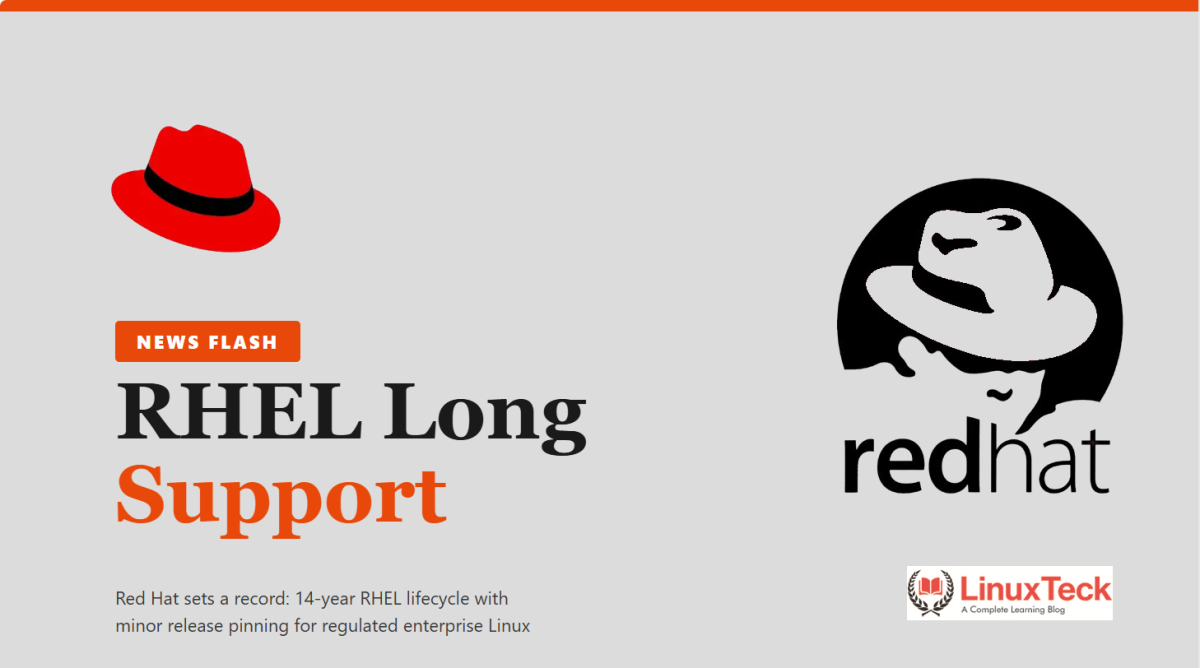
- Red Hat launched RHEL Extended Life Cycle Premium on April 6, 2026 — a brand new stand-alone subscription that pushes RHEL major version support to a record 14 years.
- The subscription adds 4 years on top of the standard 10-year RHEL lifecycle, plus 6 years of extended maintenance for even-numbered minor releases like RHEL 9.2, 9.4, and 9.6.
- CVE coverage applies to Critical, Important, and Moderate vulnerabilities with a CVSS score of 7.0 or higher — not blanket patching of every CVE in the database.
- 24x7 Severity 1 and Severity 2 support SLAs are included, making this directly relevant to regulated sectors: healthcare, finance, defence, and government.
- Ubuntu Pro still technically offers 15 years of coverage, but the structural model is very different — this comparison is worth understanding before you sign any contract.
What Happened
Red Hat Just Set a New Bar for Enterprise Linux Longevity
On April 6, 2026, Red Hat announced the General Availability of RHEL Extended Lifecycle Premium, a new stand-alone subscription option for organizations needing to run a Major Version of RHEL beyond the Standard End-of-Life (EOl) Date. The new subscription program is NOT an upgrade or add-on to existing subscriptions; rather, it represents a New Product Tier from Red Hat, which represents their greatest commitment to support for any product to date.
Standard RHEL coverage currently lasts for ten years. With the addition of four additional years through this new subscription service, coverage will now last for fourteen.
Technical Details
RHEL Extended Life Cycle Premium: What It Actually Covers
The details of RHEL Extended Life Cycle Premium as follows -- the meat of the matter, no sales speak. It will cover the entire major release for a period of 14 years. Even number minor releases within that time frame will receive 6 years of additional maintenance (ie., RHEL 9.2, RHEL 9.4, RHEL 9.6). As anyone who has run environments requiring full recertification after every single OS-level update knows; this is not a small distinction.
This subscription provides security support through patching of CVEs (Critical, Important, or Moderate) with a CVSS score of 7.0 and higher. This way, Security can focus on the fixes that affect exploitability and avoid having to sift through patches of lower priority CVEs which could potentially introduce new risks. The 24x7 Severity 1 & Severity 2 Support Service Level Agreement (SLA) supports operational teams who cannot afford to wait until Monday morning for assistance.
"Enterprises in regulated industries need to know that their platform will remain secure and supported throughout the full lifecycle of the hardware they are running on and any certification requirements (not just until the next upgrade window opens up)."
— Red Hat Enterprise Linux Product Team, April 2026
Why It Matters
Even-Numbered Minor Release Pinning — The Detail That Changes Everything
Most coverage of this news will be centered around the 14 year headline. While that is certainly the most publicized aspect of this announcement, the even numbered minor release support is arguably much more operationally relevant. The reason behind its importance in the real world is as follows.
In industries such as medical devices, defence systems, financial trading infrastructure etc., a software certification is tied to a specific version of operating system. Therefore when you change operating system versions, your certification must then go through the complete review process all over again. This could take months and cost significant budget. With 6-year support for even-numbered minor releases, an organization can run on RHEL 9.4 for six years, get security patches, and never trigger recertification. To many organizations, this is not just convenience, it is regulatory necessity.
Rocky Linux and AlmaLinux users watching from the sidelines should take note of the above. This is exactly the kind of commercial differentiation Red Hat is leaning into after the centos transition. See our coverage of systemd 260 dropping SysV init support and Fedora 44 beta to understand where the upstream is heading while downstream users debate lock-in.
Timeline
How RHEL's Support Model Has Evolved
-
1Pre-2012Standard RHEL lifecycle offered 7-year support. Enterprise customers frequently complained about upgrade pressure before infrastructure was ready.
-
22012 — 2022Red Hat extended the standard RHEL lifecycle to 10 years, making it one of the longest commitments in commercial enterprise Linux. CentOS served as the free downstream option throughout this period.
-
3June 2023Red Hat restricted public RHEL source code access, triggering a major community response and accelerating investment in Rocky Linux and AlmaLinux as alternatives.
-
42024 — 2025Extended Life Cycle Support (ELS) add-on already existed for specific RHEL versions, but was positioned as a bridge — not a long-horizon product. Canonical began aggressively marketing Ubuntu Pro's 15-year coverage in this period.
-
5April 6, 2026Red Hat launches RHEL Extended Life Cycle Premium as a stand-alone subscription. 14 years of total support, 6-year even minor release pinning, CVSS 7+ CVE coverage, and 24x7 Sev 1/2 SLAs — the most comprehensive lifecycle commitment Red Hat has ever offered.
Industry Comparison
Ubuntu Pro 15-Year vs RHEL 14-Year — Not the Same Thing
Canonical compares the two models as if it’s just simple math: 15 years of support vs. 14 years. However, there is an enormous difference in how the two product families were structured that will be critical for all enterprise architects to assess when making a purchase decision.
In Ubuntu Pro, there are three distinct layers of support. An initial LTS base supports the distro for 5 years. Next, after that five year period expires, an Extended Security Maintenance is available for another additional 5 years. And finally, after those ten years expire, Legacy Support can be added for an additional 5-year period. Each layer of support has its own unique scope and level of patching. In addition, the last layer of support would require a new contract. The RHEL ELC Premium model provides a single life cycle of a distro from day one. All of the patches, updates, etc., for the entire 14-year life cycle are covered under this single model. Therefore, you always know what you are going to get for the duration of the 14-years.
To gain further insight into how security vulnerabilities may have been addressed across various distros in 2026, we wrote an article about a security vulnerability found in Ubuntu desktop . This article provides examples of how Canonical handles patching timelines in real-world scenarios.
| Aspect | RHEL Extended Life Cycle Premium | Ubuntu Pro (15-Year) |
|---|---|---|
| Total support duration | 14 years | 15 years |
| Support model structure | Single unified lifecycle for major branch | Stacked layers (LTS + ESM + Legacy add-on) |
| Minor version pinning | Yes — even-numbered minor releases, 6-year window | No equivalent feature |
| CVE coverage scope | Critical, Important, Moderate (CVSS ≥ 7) | Security updates vary by ESM tier |
| 24x7 Sev 1/2 SLA | Included | Depends on support contract tier |
| Designed for regulated industries | Yes — explicit positioning | Partial — not primary positioning |
| Certification lock-in support | Yes — even minor release pinning addresses this directly | No equivalent |
| Contract complexity | Single subscription | Multiple tiers, potential for contract gaps |
Who Should Consider This
Is RHEL Extended Life Cycle Premium Right for Your Organization?
While this will not be a viable option for all Red Hat Enterprise Linux (RHEL) shops, if your team is running a predictable cadence of upgrades, and you have no certification issues, then the standard RHEL lifecycle should suffice. For other environments though, this is not an option, it's your only viable commercial choice.
| Organization Type | Recommendation | Why |
|---|---|---|
| Healthcare (FDA-regulated software) | Strong YES | OS updates trigger recertification; minor version pinning is a direct solution |
| Defence and government agencies | Strong YES | Long hardware cycles, strict compliance requirements, cannot risk unsupported platforms |
| Financial trading infrastructure | Strong YES | Uptime SLAs demand long-term OS stability; compliance audits require supported software |
| Hardware-locked environments | Strong YES | Cannot upgrade hardware; need OS support that outlasts the machine lifecycle |
| ISVs with RHEL-certified applications | YES | Certification locked to a specific RHEL version; pinning avoids costly re-certification cycles |
| General enterprise IT with normal upgrade cycles | Probably NOT needed | Standard 10-year lifecycle is sufficient; added cost unlikely to be justified |
| Rocky Linux / AlmaLinux shops evaluating commercial options | Evaluate carefully | Worth pricing out for critical workloads; free alternatives still viable for non-regulated use |
LinuxTeck Take
Red Hat Is Playing the Long Game — and This Is the Right Move
There’s an explanation for why this product has come out when it did and not in the past three years. The loss of trust from the CentOS migration affected a very large portion of the Linux user base. As such, many of these former RHEL adjacent (users) are being absorbed by Rocky Linux and AlmaLinux. Red Hat isn’t making this announcement to regain some or all of these users; instead, they’re simply further focusing their efforts on a market segment which was always less likely to abandon them. These include heavily regulated and highly certified organizations within extremely slow moving enterprises.
For these types of organizations fourteen years of complete, contractually defined security protection through a single OS branch, as well as full security vulnerability coverage according to a CVSS scale (Common Vulnerability Scoring System), is not something that could possibly be described as an “upsell” – it would be nothing but another way of describing what is required of them in order to meet their regulatory obligations while using a particular piece of software. The gap of one year between RHEL and Ubuntu Pro’s fifteen year promise is practically irrelevant to how things actually work. It comes down to whether there will be contractually defined certainty around the minor versions of an operating system, as well as the length of time and type of support that will be provided for each major version. This is what your compliance teams need to approve before signing off on an agreement.
If you use RHEL on hardware that has been installed since the Obama Administration, and if you’ve had no updates to your software certifications since 2021, then it is probably time to sit down with someone and seriously discuss this subscription. If you don't fall into either of these categories, then the standard ten year life cycle works perfectly well for most people.
Follow along with us for breaking enterprise Linux news as we cover the latest developments in Samba 4.24, the Linux 7.0 AccECN default change, and Linux 7.0 RC4 release notes.
LinuxTeck — A Complete Learning Blog
Tech News Stay updated with the latest Linux and open-source news — covering new releases, distro updates, security patches, and enterprise developments, delivered in plain language for sysadmins and developers.