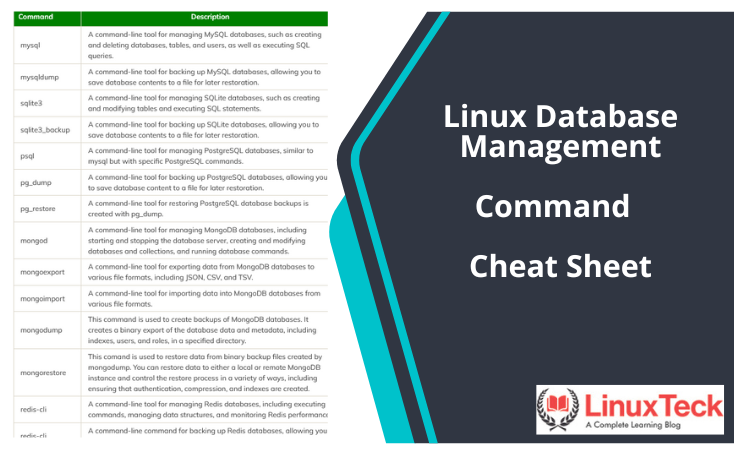
Linux input/output redirection commands redirect commands and scripts. This command allows you to specify input and output locations. You can read input from a file instead of typing it rather than displaying it on the screen. The output of multiple commands can also be filtered and modified using redirection commands. They provide a powerful and flexible way to control Linux data flows.
| Command | Description |
|---|---|
| ">" | Used to redirect output to a file, creating a new file if it doesn't exist or overwriting the existing file if it does. |
| ">>" | Used to redirect output to a file, but appending the output to the end of the file instead of overwriting it. |
| "<" | Used to redirect input from a file, with the contents of the file being used as input to the command. |
| "<<" | Used to redirect input from a "here document", which is a way to pass input to a command without using a file. |
| "&>" | Used to redirect both standard output and standard error to a file, creating a new file if it doesn't exist or overwriting the existing file if it does. |
| "&>>" | Used to redirect both standard output and standard error to a file, but appending the output to the end of the file instead of overwriting it. |
| "2>" | Used to redirect standard error to a file, creating a new file if it doesn't exist or overwriting the existing file if it does. |
| "2>>" | Used to redirect standard error to a file, but appending the output to the end of the file instead of overwriting it. |
| "|" | Used to redirect the output of one command as input to another command, creating a pipeline of commands. |
| "tee" | Used to redirect output to a file, while still displaying the output on the screen. |
| "<<<" | Used for here strings, which allow you to specify input directly in a variable. |
| "<>" | Used to open a file for both reading and writing. |
| ">&" | Used to redirect standard output and standard error to a file descriptor. |
| "<()" | Used for command substitution, which allows the output of a command to be used as input for another command. |
| ">()" | Used for process substitution, which allows the output of a command to be used as input for another command as a file. |
| "script" | Used to record a shell session to a file for later replay. |
| "/dev/null" | Used to discard output, effectively sending it into a "black hole". |